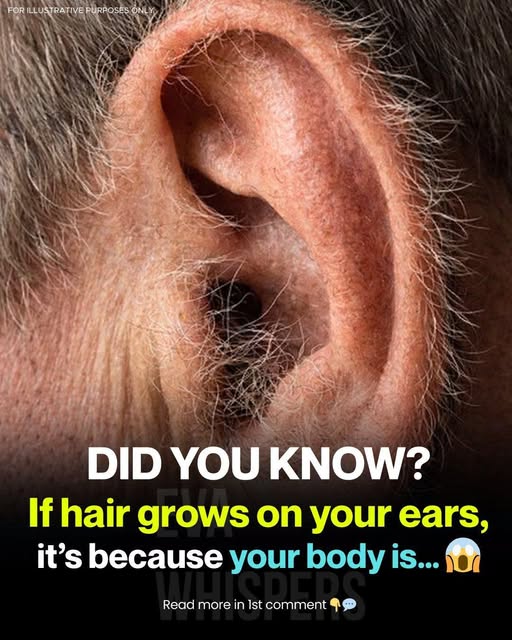
Have you ever looked in the mirror and noticed hair growing on your ears and thought, “When did that happen?” You’re not alone. Ear hair is one of those changes that seems to appear quietly with age, often catching people by surprise. While it’s easy to laugh it off or blame genetics, ear hair growth can actually reflect a mix of biological processes happening inside your body. It’s rarely dangerous—but it is interesting, and sometimes informative.
Let’s unpack what ear hair growth really means and what your body might be signaling.
1. Hormones Are Shifting (Especially Testosterone)
One of the biggest reasons ear hair grows is hormonal change, particularly involving testosterone. As men age, testosterone levels don’t just decline—they also fluctuate. Hair follicles in certain areas, including the ears, nose, and eyebrows, can become more sensitive to this hormone over time.
This sensitivity causes thicker, darker, and longer hair growth in places that were previously barely noticeable. That’s why ear hair is far more common in middle-aged and older men than in younger people or women.
In short:
If hair grows on your ears, it’s because your body is responding differently to hormones than it did years ago.
2. Aging Changes How Hair Follicles Behave
Aging doesn’t just give you wrinkles—it changes how your hair follicles function. Some follicles shrink and stop producing hair (hello, thinning scalp), while others become overactive.
Ear hair follicles tend to fall into the second category. With age:
The hair growth cycle slows
Hair becomes coarser and longer
Trimming feels like a never-ending task
This is a normal biological process, not a sign that something is “wrong.” It’s simply part of how the body reallocates resources as it gets older.
3. Genetics Play a Bigger Role Than You Think
If your father, grandfather, or uncles had noticeable ear hair, chances are you might too. Genetics strongly influence:
Where hair grows
How thick it becomes
How early it appears
Certain populations and ethnic backgrounds are more prone to ear hair growth due to inherited traits affecting hair follicles and hormone sensitivity.
So sometimes, if hair grows on your ears, it’s because your body is following a genetic blueprint written long before you were born.
4. Your Body Hair Pattern Is Rebalancing
Hair growth isn’t random—it’s regulated by complex signals between hormones, skin, and hair follicles. As you age, your body redistributes hair growth. That’s why many people experience:
Thinner hair on the head
More hair on ears, nose, eyebrows, chest, or back
This rebalancing doesn’t mean your body is malfunctioning. It’s adapting to internal changes, especially shifts in circulation, hormones, and cellular renewal.
5. It Can Be Linked to Overall Hair Follicle Sensitivity
Some people simply have hair follicles that react strongly to internal signals. These follicles are more likely to:
Produce thicker hair
Grow hair faster
Extend the hair’s growth phase
Ear hair growth can be a visible sign of that sensitivity. While it’s mostly cosmetic, it shows how responsive your skin is to hormonal and biological cues.
6. Is Ear Hair a Sign of a Health Problem?
In most cases, no. Ear hair by itself is not a disease or a warning sign of serious illness. However, extremely rapid or unusual hair growth combined with other symptoms—such as sudden hormonal changes, fatigue, or unexplained weight shifts—may warrant a medical check-up.
But for the vast majority of people, ear hair growth is:
Normal
Harmless
Age-related
It’s more about biology than pathology.
7. Why It Seems to Grow Overnight
One of the most frustrating things about ear hair is how suddenly it seems to appear. This happens because ear hair is often:
Light-colored at first
Hidden by the ear’s shape
Slow-growing until it reaches a noticeable length
Once it crosses that visibility threshold, it feels like it popped up overnight—even though it’s been growing quietly for weeks.
8. Grooming Is a Choice, Not a Necessity
There’s no medical reason to remove ear hair unless it causes discomfort or hygiene issues. Many people choose to trim or remove it for personal or cultural reasons, and that’s perfectly fine.
Safe options include:
Electric trimmers designed for ears
Professional grooming
Careful trimming (never deep plucking, which can irritate skin)
What matters most is doing it safely and comfortably.
The Bottom Line
If hair grows on your ears, it’s because your body is responding to age, hormones, genetics, and natural biological changes. It’s a common, normal part of life—especially for men—and not something to be embarrassed about.
Think of ear hair as a quiet reminder that your body is always evolving. It may not be the most glamorous change, but it’s a very human one. And like laugh lines or gray hair, it tells a story of time, biology, and individuality—one strand at a time.
