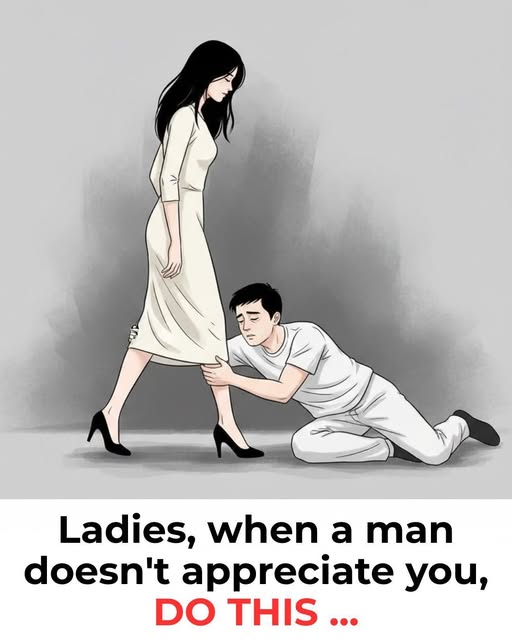
When a man doesn’t appreciate you, it can quietly drain your confidence, your joy, and even your sense of self. Appreciation isn’t about grand gestures or constant praise—it’s about feeling seen, valued, and respected for who you are and what you bring into a relationship. If that’s missing, something important is broken. Here’s what you should do when you realize you’re giving more than you’re getting.
First, pause and get honest with yourself.
Before confronting anyone else, check in with your own feelings. Do you feel taken for granted? Do your efforts go unnoticed? Are you always the one compromising, understanding, or fixing things? Appreciation shows up in consistent ways—listening, respect, effort, gratitude. If you’re constantly making excuses for his behavior or minimizing your hurt, that’s a sign you already know the truth. Your feelings are data. Don’t ignore them.
Second, stop over-giving to earn value.
One of the biggest mistakes people make is giving more when they feel unappreciated—more love, more patience, more effort—hoping it will finally be recognized. Unfortunately, over-giving often teaches the other person that your needs don’t matter. Love is not a performance where you prove your worth. If he only values you when you exhaust yourself, that’s not appreciation—it’s convenience. Pull back to a level that feels healthy and balanced.
Third, communicate clearly, not emotionally.
If the relationship matters to you, speak up—but do it with clarity, not desperation. Avoid accusations like “you never” or “you always.” Instead, be direct and grounded: “I don’t feel appreciated when my efforts go unnoticed,” or “I need more respect and acknowledgment in this relationship.” His response will tell you a lot. A man who values you will listen, reflect, and try to improve. A man who doesn’t will deflect, dismiss, or blame you for having needs.
Fourth, watch actions, not promises.
Words are easy. Real appreciation shows up in behavior. Does he make an effort after the conversation, or does everything go back to normal in a week? Does he respect your boundaries, or test how much you’ll tolerate? Change doesn’t have to be perfect, but it should be visible and consistent. If his actions don’t match his words, believe the actions. They’re the truth.
Fifth, reconnect with your own life.
When you’re not appreciated, it’s easy to shrink your world around the relationship. Do the opposite. Invest in your friendships, goals, health, and passions. The more grounded you are in your own life, the clearer your thinking becomes. Appreciation starts with you. When you value yourself, you naturally stop accepting crumbs. Confidence isn’t loud—it’s quiet certainty that you deserve better.
Sixth, set boundaries—and mean them.
Boundaries are not ultimatums; they’re standards. Decide what you will and will not tolerate. That might mean no longer doing emotional labor that isn’t reciprocated, or refusing to accept disrespect disguised as “jokes” or neglect disguised as “being busy.” The key is follow-through. A boundary without consequences is just a request. When you enforce your limits calmly, you teach people how to treat you.
Seventh, accept when it’s time to walk away.
This is the hardest part, but sometimes the most loving thing you can do—for yourself—is to leave. You cannot force someone to appreciate you. You can only decide how long you’re willing to stay where you are undervalued. Walking away doesn’t mean you failed. It means you chose self-respect over comfort. The right person will never make you feel like you’re asking for too much when you’re simply asking for basic appreciation.
Finally, remember this truth.
You are not “too much.” You are not needy for wanting to be valued. Appreciation is not a luxury in a relationship—it’s the foundation. A man who truly cares won’t need to be convinced of your worth. He’ll see it, honor it, and protect it. And if he doesn’t, your job isn’t to change him. Your job is to choose yourself.
