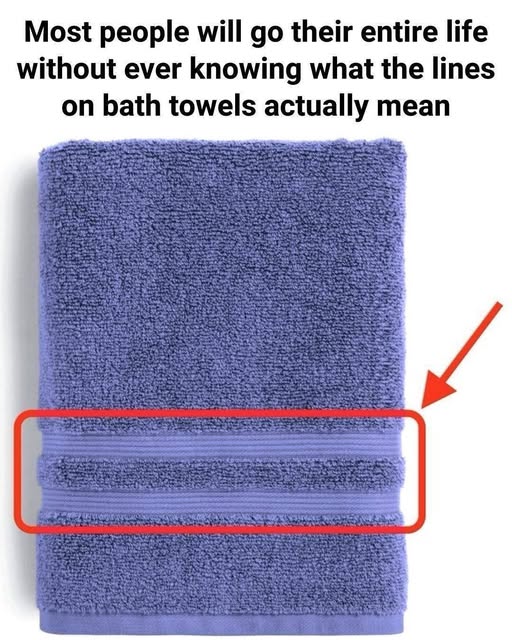
Take a close look at your bath towel and you’ll probably notice it: a set of neat, horizontal lines woven near the ends, sometimes called borders or bands. Most of us have used towels our entire lives without ever questioning this detail. Are they just decorative? A leftover tradition from old textile designs? Or do they actually serve a purpose?
The short answer: those lines are far more practical than they look. They play an important role in how towels absorb water, stay durable, dry efficiently, and even feel comfortable against your skin. Let’s unravel the surprisingly clever design behind this everyday household item.
The Lines Have a Name: Dobby Borders
Those lines on bath towels are technically known as dobby borders. The term comes from a special weaving technique (the dobby loom) that creates tight, flat patterns in fabric. Unlike the fluffy loops that make up the main body of a towel, dobby borders are woven more densely and smoothly.
This difference in structure is the key to why towel manufacturers include them.
1. They Prevent Fraying and Extend Towel Life
One of the most important functions of towel lines is structural reinforcement.
The main part of a towel is made of looped fibers (called terry loops). These loops are excellent for absorbing water, but they’re also more vulnerable to pulling, stretching, and fraying over time—especially near the edges, where wear and tear is highest.
The tightly woven lines act like a protective barrier, strengthening the towel’s ends and helping it keep its shape after repeated washing and drying. Without these reinforced sections, towels would unravel much faster.
In simple terms:
The lines help your towel last longer.
2. They Help the Towel Dry Faster
It might seem counterintuitive, but those less-absorbent bands actually improve drying performance.
Because dobby borders don’t hold as much water as the fluffy terry fabric, they allow moisture to escape more easily. This creates better airflow when the towel is hanging on a rack or line, helping the entire towel dry more evenly and quickly.
This faster drying isn’t just convenient—it also helps reduce musty smells and bacterial growth, which thrive in damp fabrics.
3. They Improve Absorbency Where It Matters Most
You might wonder: if the borders absorb less water, isn’t that a bad thing?
Not at all. By limiting absorbency at the edges, towel designers ensure that the central area remains the main drying zone. This balance prevents the towel from becoming overly heavy and waterlogged at the ends, which would make it harder to use and slower to dry.
Think of it as smart design: maximum softness and absorbency where your skin needs it, and stability where the towel needs strength.
4. They Keep Towels Flat and Easy to Fold
Ever noticed how towels with borders tend to fold more neatly?
The lines provide visual and physical structure, acting as a natural guide when folding. Hotels and spas rely heavily on this feature to achieve that crisp, uniform look you see in guest rooms and bathrooms.
The denser weave also helps prevent curling at the edges, which is common in towels without reinforced borders.
5. They Add Comfort and Prevent Irritation
While terry loops are great for drying, they can feel rough if they rub repeatedly against sensitive skin—especially along the edges.
The smooth dobby border reduces friction, making the towel more comfortable around the neck, face, and hands. This is particularly helpful for people with sensitive skin or for baby towels, where comfort is a top priority.
6. They Help Identify Towel Size and Orientation
This is a small but practical benefit many people overlook.
Those lines make it easier to quickly identify the top and bottom of a towel, especially when it’s folded or hanging. In shared households, gyms, or hotels, this subtle detail improves usability without anyone consciously noticing it.
7. Yes, They’re Decorative—But That’s Not the Main Reason
Of course, towel lines also serve an aesthetic purpose. They add elegance, variety, and a sense of design to what would otherwise be a plain rectangle of fabric. Manufacturers often use borders to differentiate styles, brands, or collections.
But decoration is more of a bonus than the main goal. The real reason those lines exist is functionality.
What Happens If a Towel Has No Lines?
Some modern or minimalist towels skip borders entirely. While these can still work, they often:
-
Wear out faster at the edges
-
Take longer to dry
-
Lose shape after repeated washing
That’s why high-quality towels—especially those used in hotels—almost always include reinforced borders.
The Takeaway
Those simple lines on your bath towel are a perfect example of hidden design intelligence. They’re not just there to look nice—they strengthen the fabric, improve drying, enhance comfort, and extend the towel’s lifespan.
So next time you grab a towel after a shower, take a second look at those bands near the edges. They’re quietly doing a lot of work, proving that even the most ordinary household items are often smarter than we think.
